

A single platform to unify your customer communication
Centralize email, SMS, RCS, WhatsApp, and voice for a unified customer experience. Reach more customers by communicating on the right channel, at the right time.
4 benefits
What the omnichannel platform changes
Reach every customer where they actually read
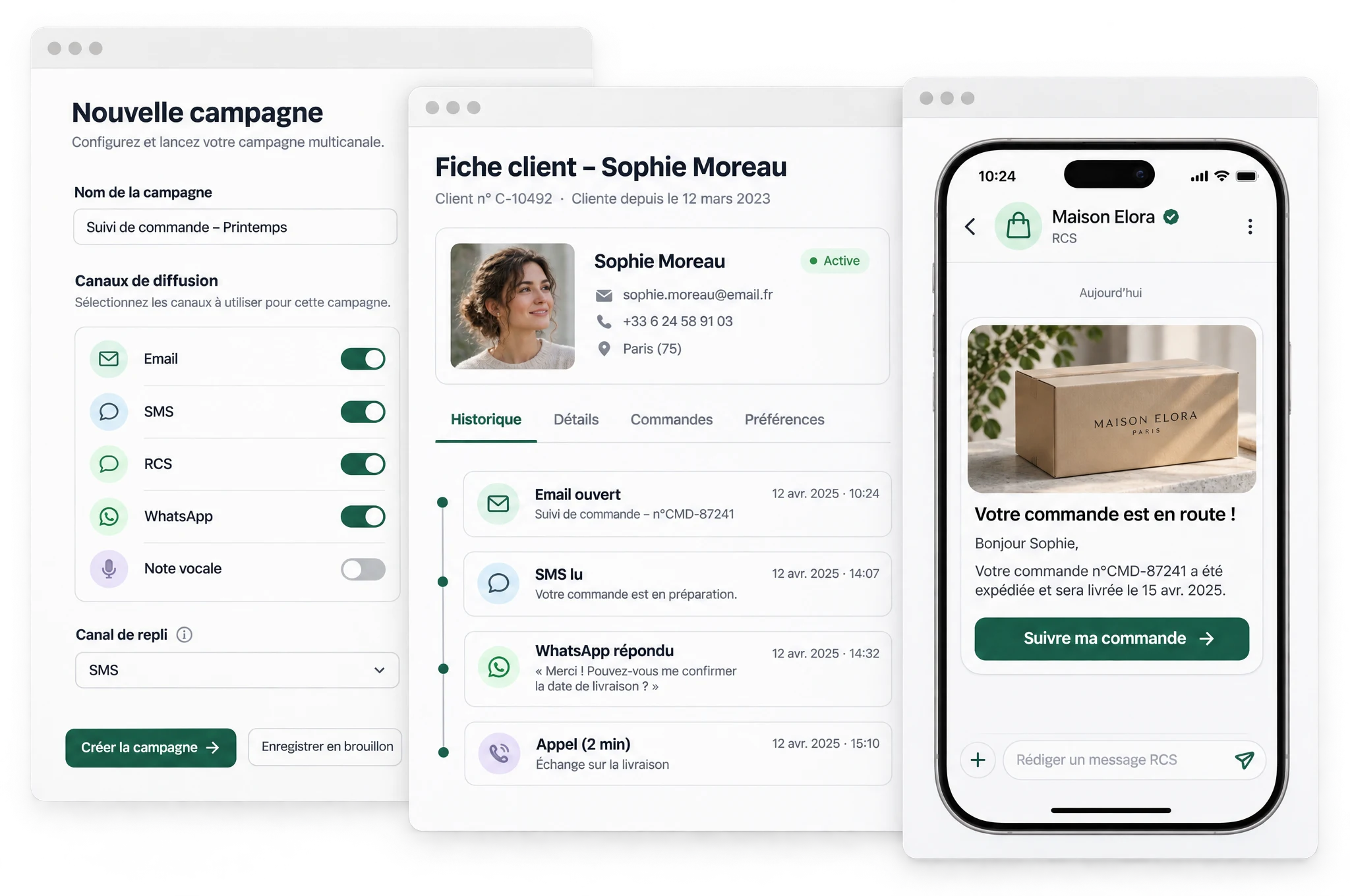
The right message, on the right channel. SMS, email, RCS, WhatsApp, voice message: choose the most suitable channel for each customer and situation. If a message is not delivered or read, OPPY can automatically switch to another channel. Your important information reaches its destination.
Prevent rather than manage follow-ups
Inform before they call you. Appointment confirmations, order tracking, payment reminders, practical information: by being proactive, you reduce no-shows, missed appointments, and incoming "where is my order?" calls. Your team saves time for the requests that really matter.
A continuous relationship, not isolated messages
Your customers respond, and the conversation continues. With conversational channels (RCS, WhatsApp, SMS replies), customers can react directly to the message received: confirm, reschedule, or ask a question. Exchanges remain linked to their history and can be picked up by a member of your team at the right time. The customer never has to start from scratch.
Simple to manage, compliant by default
All your channels, one single platform. Create, schedule, and track your messages from one place, with no technical skills required. With unsubscribe management, GDPR compliance, and data hosted in France, you can communicate with your customers with complete confidence and measure what works.
FEATURES
Use cases
Stay ahead across all your channels
Your teams notify your customers at the right time and on the right channel, even before they need to contact you.
The next channel takes over
No response to the email? An RCS message is sent. Still nothing? A voice message. Your campaigns automatically adapt to each customer's behavior.
Your tools trigger, OPPY communicates
An order is shipped, an appointment is booked, an invoice is issued: your systems send the information, and OPPY notifies the customer on the right channel. The result is then fed back into your tools.


How it works

Create your omnichannel campaigns on Oppy
Email, SMS, RCS, WhatsApp, voice.
Consolidate customer history
In a single profile via your CRM
Orchestrate and measure
Orchestrate your interactions and measure overall performance.
Numbers speak louder than words
FAQ
What is an omnichannel platform?
An omnichannel platform is a tool that allows a company to communicate with its customers across all channels from one single place: email, SMS, RCS, WhatsApp, voice message, or automated call. Its difference from a multichannel solution can be summed up in one word: coordination. A multichannel solution uses several channels side-by-side, each on its own. An omnichannel platform makes them work together: the channels share the same information about the customer, hand off to one another based on their reactions, and follow the same scenario. In practice, if a customer doesn't read an email, an SMS can take over. If they reply on WhatsApp, their response is taken into account in the rest of the journey. And every interaction remains visible in their history. For the company, it is the guarantee of reaching every customer on the channel they actually check, without duplicates or contradictory messages. For the customer, it is a simple and continuous relationship, regardless of the channel used.
How does Oppy connect my different channels?
Channels (email, SMS, RCS, WhatsApp, voice) are natively integrated into the Oppy platform, with no third-party connectors to install: they all feed into the same customer profile and the same dashboard.
Can I measure the performance of my journey across all channels?
Yes. With OPPY, you don't just track each channel separately: you see the performance of your entire journey. For each campaign, you know how many customers were reached, on which channel, and at what stage they reacted. This allows you to identify the channel that actually triggered the action, whether it was an appointment confirmation, a payment, or a response. You can also spot friction points: a stage where customers drop off, a channel that performs less well than another for a certain type of message, or a less effective time of day for sending. These metrics allow you to adjust your journey on the fly: change the order of channels, modify a follow-up delay, or revise a message. Each campaign becomes more effective than the last.
How long does it take to create an omnichannel campaign?
Much less than you might think. With OPPY, there is nothing to install or configure on the technical side: your channels are ready to use as soon as you open your account. To build your scenario, you start with your goal: confirming an appointment, following up on an invoice, or providing delivery updates. You then choose the channels, the order in which they are used, and the delays between each message. For example: an RCS message first, followed by an SMS if the message hasn't been read within 24 hours. You write your messages, select your recipients, and schedule the send. A simple initial campaign can be launched quickly. Once your scenario is created, it is reusable: subsequent campaigns require only a few adjustments. And if you need help getting started, the OPPY team will support you in building your first journeys.
Unify your customer communication now
All your channels. One single platform.